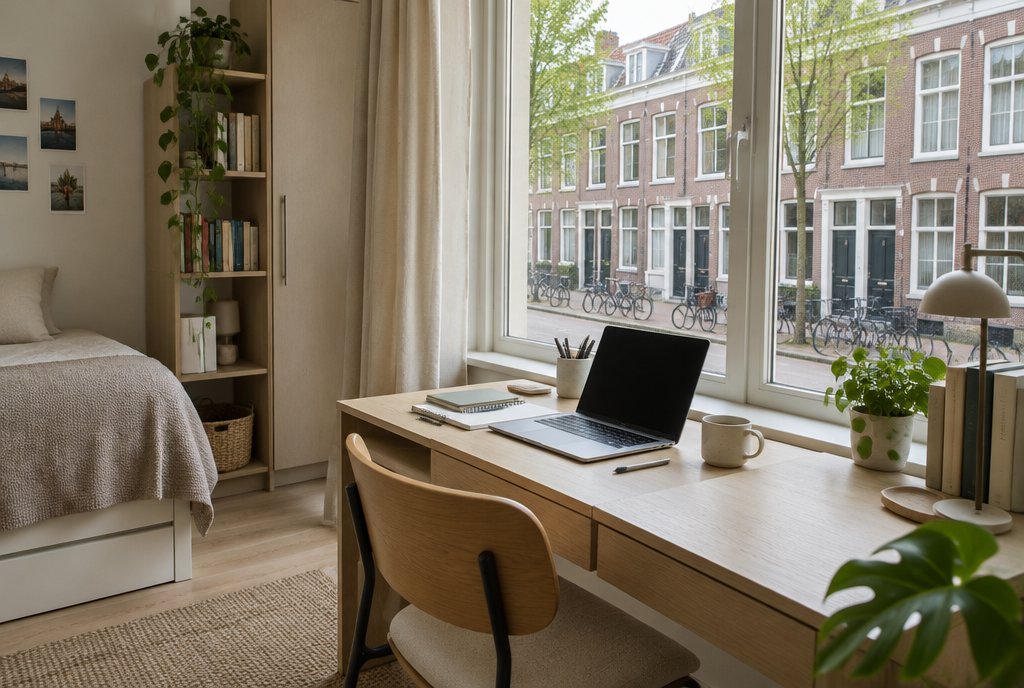
You moved to Rotterdam for Erasmus, RSM, Codarts or Erasmus University College. The acceptance letter was the easy part. Finding a place to live is something else entirely.
This guide is direct. It explains why the Rotterdam rental market is harder than the average European student city, where to actually look, what landlords care about, how to spot scams, and what to do if nothing is working. We have been working as estate agents in Rotterdam for years. The advice below is what we tell our own clients.
A note on what we do and do not handle. We do not rent out rooms in shared student houses and we do not arrange hospiteer-style placements. Our rental search service covers self-contained studios and apartments, typically for students whose housing is paid for by a parent, sponsor or company. The room-market parts of this guide are informational: that is how that market works, and that is how you handle it yourself.
Why housing in Rotterdam is harder than you expected
Rotterdam has a structural housing shortage. Erasmus University alone has over 30,000 students, and thousands more study at Codarts, Hogeschool Rotterdam and Erasmus University College. Add international workers in finance, shipping and tech, and demand far outweighs supply.
A few specifics that matter for you:
- Most rooms are listed for less than 48 hours. Some never appear publicly at all and go through word of mouth.
- Dutch landlords often prefer Dutch-speaking tenants. Not because they have to, but because communication and contracts are easier.
- Many landlords prefer working professionals over students, because rental income is more stable.
- Scams targeting international students are common, especially before the academic year starts.
The takeaway: this is not a market where you scroll a website on the day you arrive and find a place by the weekend. You need to start early, look in more places than you think, and prepare to move quickly when you find something.
Where to actually look
Most international students rely on three or four channels. The most successful students use seven or eight. Spread your search.
Official student housing
Apply early. These are the most affordable options and the easiest to arrange from abroad, but availability is limited.
- Erasmus University Housing Office: direct allocations for exchange students and a limited number of degree-seeking internationals.
- DUWO: a large student housing corporation. Long waitlists, but worth registering on day one.
- SSH Student Housing: works with several Dutch universities and sometimes has Rotterdam capacity.
Private rental platforms
This is where most international students find their first place. Be ready to refresh, react fast and message landlords with a polished short message.
- Pararius: the cleanest platform, mostly mid-budget and upwards.
- Funda: primarily for buying, but also has rentals from registered agents.
- Kamernet: student-room focused, paid membership but high listing volume.
- HousingAnywhere: designed for international students, mid-term rentals.
- Spotahome: verified listings, good if you want to book remotely before arriving.
Facebook groups and word of mouth
- “Rotterdam housing” and “International students in Rotterdam” Facebook groups have daily listings and sublets.
- Ask current students at your faculty. The fastest finds are almost always through someone who knows someone.
- Check noticeboards at your university and at faculty buildings on campus.
Estate agents
A local agent like us can search proactively across landlords and listings that never reach public platforms. We charge a fee, so this only makes sense if your situation requires certainty, if you are arriving on a fixed date, or if a parent or company is arranging housing on your behalf. More on that below.
Where to live: Rotterdam neighbourhoods for students
Most international students concentrate in three or four areas. Where you should look depends on your university and budget.
Centrum and Cool
The city centre. Walking distance to most nightlife, restaurants and the central station. Studios and small apartments dominate. Expect to pay €900 to €1,400 for a small studio. Good for students who want to live in the city itself and can afford it.
Kralingen
Closest to Erasmus University campus. Quieter, greener, family-oriented but with a strong student presence. Good cycling routes to campus. Studios from €800, rooms from €600 if you can find one.
Delfshaven and Witte de Withkwartier
Creative, multicultural, lively. Popular with Codarts and Hogeschool students. More room-sharing options, slightly lower budgets. €500 to €900 for a room, depending on the building.
Noord and Blijdorp
Less central but well connected by tram and metro. Family neighbourhoods with affordable apartments. Good if you prioritise space over centrality.
Hillegersberg and Schiebroek
Quieter, more residential, popular with international families and senior students. Higher budget, more space. Less typical for first-year students but a strong option if you are studying for several years or living with a partner.
What landlords actually select on
When ten people apply for the same apartment in two hours, the landlord does not pick at random. They prioritise. Knowing what they look at helps you position yourself.
In rough order of importance:
- Proof of income or financial backing. Landlords typically want monthly income of three to four times the rent, evidenced by an employment contract or, for students, a sponsorship letter or parental guarantee.
- Length of stay. Landlords prefer tenants who stay at least twelve months. Six-month exchange students are at a disadvantage.
- Identity documents. Passport, BSN if you have one, university enrolment letter, employment contract for working students.
- A professional first message. Short, polite, in English or Dutch, with your basics: who you are, when you arrive, how long you stay, who pays the rent.
- No surprises. No pets without permission, no co-tenants who were not mentioned, no last-minute changes to who is moving in.
A polished email with the right documents attached, sent within an hour of a listing going live, beats a slow reply from a stronger candidate. Speed and preparation matter more than perfect Dutch.
Common scams and how to spot them
Rental scams targeting international students spike between June and September. The pattern is always the same: a listing that looks too good for its price, a landlord who cannot meet in person, and a request to transfer a deposit before you have seen the apartment.
Red flags:
- The price is significantly below market for the location.
- The landlord is “abroad” and cannot do a viewing.
- They ask for a deposit by bank transfer or, worse, cryptocurrency before you have signed anything.
- They pressure you to decide within hours, citing other interested tenants.
- The listing appears on multiple platforms with different contact details.
Rules to live by:
- Never pay before viewing the property in person or having a trusted person view it for you.
- Never pay a deposit before signing a written rental agreement.
- Never transfer money outside the Netherlands without verification.
- Check who owns the property in the official Kadaster records if anything feels off.
If a deal feels too good to be true, it usually is. Walking away from a scam costs you nothing. Falling for one costs you a deposit and weeks of stress.
Realistic budget for a student in Rotterdam
What you can expect to pay, all-in including utilities, internet and basic groceries:
- Shared room or small studio: €700 to €1,100 per month.
- Independent studio in a popular area: €1,100 to €1,600 per month.
- One-bedroom apartment: €1,300 to €1,900 per month.
Prices have risen significantly in recent years, especially for studios and one-bedroom apartments. Budget realistically. Lowballing your search by €200 per month often means waiting two extra months for a place.
When professional rental support makes sense
For most students, finding housing through the channels above works eventually. It is stressful but doable.
There are situations where a professional rental agent saves time and money:
- You are arriving on a fixed start date and cannot afford weeks of uncertainty.
- A parent or sponsor is arranging your housing from abroad and wants someone local to verify properties and contracts.
- A company is relocating you to Rotterdam for an exchange programme, MBA or graduate placement, and is covering housing costs.
- You have already lost time to scams or cancelled deals and want certainty.
Our rental search support service does the work for you. We focus on self-contained studios and apartments, not rooms in shared student houses. We tap into a network of landlords and listings that are often not advertised publicly, attend viewings on your behalf if needed, negotiate terms, review the rental agreement and attend the key handover.
The fee is one month’s rent excluding VAT, charged only when the rental agreement is actually signed. No upfront costs. For students whose housing is paid by parents or a sponsoring company, this is often the most efficient way to skip weeks of searching.
If that fits your situation, get in touch with Julia for a quick assessment.
Frequently asked questions
How early should I start looking for student housing in Rotterdam?
Start three to four months before your arrival date, especially if you are coming for the September intake. The closer you get to the academic year, the more competitive the market becomes.
Can international students rent without a Dutch BSN number?
Yes. You can sign a rental agreement before you have a BSN. Most landlords accept your passport, university enrolment letter and proof of income or sponsorship.
What is the average rent for a student in Rotterdam?
Expect to pay €700 to €1,100 per month for a shared room or small studio, and €1,100 to €1,600 for an independent studio in a popular area. Prices vary significantly by neighbourhood.
Do I need a Dutch guarantor to rent in Rotterdam?
Not always, but many landlords ask for one. If you do not have a Dutch guarantor, a parental guarantee letter or proof of three to four months of rent on your bank account often satisfies the requirement.
Are short-term rentals available for exchange students?
Yes, through platforms like HousingAnywhere and Spotahome, and through some private landlords. Expect to pay a premium for short-term arrangements compared to twelve-month contracts.
What should I do if I have been scammed?
Report the scam to the Dutch police via politie.nl and to the platform where you found the listing. If you transferred money, contact your bank immediately to request a recall. Save all communication as evidence.
Can Hooft Makelaardij help international students find housing?
Yes, for self-contained studios and apartments. We do not handle rooms in shared student houses or hospiteer-style placements. Our service suits students with confirmed funding, families arranging housing for a child studying in Rotterdam, and companies relocating staff. Our fee is one month’s rent excluding VAT, charged only when the rental agreement is actually signed.
Hooft Makelaardij is an NVM-registered estate agent based in Rotterdam, specialising in rentals, sales and purchases in the city and surrounding municipalities.